No news here since a long while. However, today, I read liw's bit on tag hierarchies for photos. I'd like to comment on some of his key points:
First of all, liw sees some of the key issues dealing with tags rather than notions: He mentions aliases and raises the questions whether there should be tags allowed that have more but one name. -- I'll ask another question: What about different tags sharing the same name? That's called homonymy. The other, "aliases", is synonymy.
Another thing he's asking for: What about translations for tags? -- Well, there is the issue that there are words in one language that don't have a true translation in another language. Little known, but clear is this pair in English and German: "to round out" -- "abrunden" ("to remove sharp edges"//"to round in"). Also, all the foreign-langisms any language has is a sign for that there's not yet any matching translation for a foreign word. Think "kindergarten" in English.
Second, given the translations would equal the original meaning, what else would they be but synonyms?
In my opinion, this cries for using notions rather than words.
About the synonyms, liw raises another question: What about descriptions for the tags? This could be particularly useful if you'd share tag hierarchies and one receiving person would not know a certain tag.
Let me point out some usability/convenience issue here: First, how can sharing user A know which of his tags they'd need to describe in order receiving user B will fully get what the particular tag is about? Second, why would user A want to describe any of the tags they already know? What'd be their benefit of that, their reason for doing so? And also, would the receiver actually make very much use of tags they are unfamiliar with? Then, would it be worthwhile to exercise all that effort to describe the tags?
Finally, descriptions are probably the worst source of content for machines: Content is stuck in sentences. Machines are illiterate, and for the foreseeable future this isn't going to change. The effort you put into describing tags by descriptions you unlikely will get out of there for machines to process and, thought a bit further, also not for humans to take advantage of, since machines cannot take advantage of that knowledge buried there in sentences, incomprehensible to them.
Therefore, I'd like to push a little further what liw already incorporated in his approach to tagging: implicity. liw's idea is to imply one tag into the other. (It's great to see liw is is-a/has-a agnostic in his sample tag hierarchies. -- Shift it to the notion level, and you get what I am proposing with the model of meaning (MOM) all the time.) Therefore, instead of burying precious content into machines-incomprehensible sentences, just extend the idea of tagging: show the context tags of the given tag a user might not know. The terms/tags being neighboured to it likely would give a close clue of what the tag in question is about.
I just mentioned liw's is-a/has-a agnosticity in his sample hierarchies. (I refer to his clear line of "has a" in "Europe - Finland - Helsinki" vs. is-a in "Location - Europe" in the same hierarchy.) There's one last thing I'd like to point out: Once you allow has-a relationships you'll like get a network rather than a clear hierarchy.
MOM -- my model of meaning -- might be a resource for addressing the issues liw points out. However, MOM currently is not under active development, and although I'd very much like to assist to implement that tags implicity system -- or MOM --, as I am currently occupied finding an employment, I won't be of very much help here. However, I'd be glad to see somebody implement it or parts of it. Also, I might be able to check in some of my own sources in several languages into github as a resource to draw from. -- wrs_]
Monday, October 12, 2009


Sunday, March 01, 2009
progessing...
...given the case you've got time and the right focus/objective, suddenly a knot opens and flow comes...
It's amazing, in what a short period I get done (rudimentary versions of) the major components of this project I had on my table for such a long time. This time it's the recognizer. I just implemented a primitive variant of it -- in, originally, less than twenty lines of code.
Operating on tags found in the Debian package descriptions database, it can help you to quickly determine the Debian package(s) that suit you best, just by entering a few tags making sense.
Here are some examples:

The program reads from a list of tags known to exist within the Debian package descriptions database. Five of those tags get picked, that's the first line of each output, presented like an array. The next few lines tell how many packages had how many of the picked tags. [The dotted line is minimalist debug output.] And finally, you get the list of results, i.e. packages that probably suit the user's needs best, i.e. share the most tags with the query. The last line is gimmick. It just tells the length of the results line in bytes.
To avoid to overwhelm the user by the amount of results, the amount of results provided is restricted to five.
Now, next question is where to get more collections like the Debian one, where you have items, and a few tags for each item. Are you aware of any? Could you give directions? Pointers? Hints? -- I'd be glad!
Updates: none so far
It's amazing, in what a short period I get done (rudimentary versions of) the major components of this project I had on my table for such a long time. This time it's the recognizer. I just implemented a primitive variant of it -- in, originally, less than twenty lines of code.
Operating on tags found in the Debian package descriptions database, it can help you to quickly determine the Debian package(s) that suit you best, just by entering a few tags making sense.
Here are some examples:

The program reads from a list of tags known to exist within the Debian package descriptions database. Five of those tags get picked, that's the first line of each output, presented like an array. The next few lines tell how many packages had how many of the picked tags. [The dotted line is minimalist debug output.] And finally, you get the list of results, i.e. packages that probably suit the user's needs best, i.e. share the most tags with the query. The last line is gimmick. It just tells the length of the results line in bytes.
To avoid to overwhelm the user by the amount of results, the amount of results provided is restricted to five.
Now, next question is where to get more collections like the Debian one, where you have items, and a few tags for each item. Are you aware of any? Could you give directions? Pointers? Hints? -- I'd be glad!
Updates: none so far
Tuesday, February 17, 2009
A hack makes reorganization work
Progressed further: One important step taken: reorganization, now, basically, works. That's the pre-requisite for introducing quality control to recognition.
Below, there are two renderings of basically the same net: One rendered before, the other after reorganization.
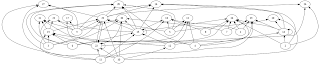

The net is broken because this reorg is a hack, and I therefore hacked together a generator too. (25) pointing to (22) and (15) pointing to itself can be seen as indicators for the brokenness of the generator.
However, what's important is that reorganization works.
Below, there are two renderings of basically the same net: One rendered before, the other after reorganization.


The net is broken because this reorg is a hack, and I therefore hacked together a generator too. (25) pointing to (22) and (15) pointing to itself can be seen as indicators for the brokenness of the generator.
However, what's important is that reorganization works.
Thursday, October 23, 2008
output of a MOM net stimulation
No, the MOM project is not gone. Because of a horrible 14-hours workday (incl. 4 hours commuting), I simply lack the time to work on MOM. However, this night I found some time to twiddle around with it, developed a very simple kind-M net net generator in Ruby which features node salting, dotty output and progression over time. Below, you find a screenshot of its output.  This screenshot shows three different states of the same MOM net.
The top one is almost the initial state. All nodes were set to a value of two, thus were active. Additionally, the net was salted. That means: Some nodes were randomly picked and their values were increased by a random value. That's why there are floating point numbers in the graph at all.
To keep the node shapes small but stay able to watch the values, I added helper nodes. Those display the values and link to their respective real node. Those helper nodes obviously aren't related to anything other but to those nodes they serve as labels for.
Note, despite the bright box in the bottom left corner of each graph, the screenshots show immediately consecutive states: Top is state 1, middle is state 2, bottom is state 3.
The center graph shows the net after one iteration. What happened to each node by now was: Every successor node (top level) got its value divided by 2.0. Every active predecessor node stimulated their successors by 1.0, every predecessor node -- active or not -- got their values divided by 2.0 too.
You may notice a color change: Nodes being still active are colored green, as well as their edges to successor nodes. Nodes not active anymore became orange now. You might also notice a different edge style now: Dotted lines means the predecessor node may have change, but at time of the screenshot it didn't effect its successor. That's for: In case some node turns green but didn't effect its successor, the dotted line makes that clear.
Another step in time, bottom graph, you notice the color of most of the nodes faded out furtherly. The links between label nodes and real nodes are solid as always. The values of originally unsalted nodes is down to 0.5.
Why this new verve? -- I just thought, it'd be a good idea to present MOM and share it with others to improve it together, rather than aiming and aiming for a perfect outcome but having that rather slowly only, because of lack of time.
Well, actually Nathan Sobo's presentation of Treetop inspired me.
Updates: none so far
 This screenshot shows three different states of the same MOM net.
 The top one is almost the initial state. All nodes were set to a value of two, thus were active. Additionally, the net was salted. That means: Some nodes were randomly picked and their values were increased by a random value. That's why there are floating point numbers in the graph at all.
To keep the node shapes small but stay able to watch the values, I added helper nodes. Those display the values and link to their respective real node. Those helper nodes obviously aren't related to anything other but to those nodes they serve as labels for.
Note, despite the bright box in the bottom left corner of each graph, the screenshots show immediately consecutive states: Top is state 1, middle is state 2, bottom is state 3.
The center graph shows the net after one iteration. What happened to each node by now was: Every successor node (top level) got its value divided by 2.0. Every active predecessor node stimulated their successors by 1.0, every predecessor node -- active or not -- got their values divided by 2.0 too.
You may notice a color change: Nodes being still active are colored green, as well as their edges to successor nodes. Nodes not active anymore became orange now. You might also notice a different edge style now: Dotted lines means the predecessor node may have change, but at time of the screenshot it didn't effect its successor. That's for: In case some node turns green but didn't effect its successor, the dotted line makes that clear.
Another step in time, bottom graph, you notice the color of most of the nodes faded out furtherly. The links between label nodes and real nodes are solid as always. The values of originally unsalted nodes is down to 0.5.
Why this new verve? -- I just thought, it'd be a good idea to present MOM and share it with others to improve it together, rather than aiming and aiming for a perfect outcome but having that rather slowly only, because of lack of time.
Well, actually Nathan Sobo's presentation of Treetop inspired me.
Updates: none so far
Saturday, May 03, 2008
Generating a basic MOM network
Just for the sake of being able to look up this later. As I am doing this over and over again in several programming languages I apply to get forth with MOM.
I need a graph of at least two distinct layers of nodes (vertices), connected by edges (arcs). The graph may not contain any loops. Therefore I select a number of bottom layer nodes -- the rest is going to be non-bottom layer nodes. For the ease of addressing both kinds of nodes, let's say, the bottom layer nodes have IDs 1..x, the non-bottom layer nodes have ID x+1..n.
To avoid loops, each bottom layer node shall be connected to a non-bottom layer node, each non-bottom layer node shall be connected to a bottom layer node.
Though desirable, this does not imply the result of graph generation will be a single graph: The generation may result in several independent graphs. -- If you are aware of a better approach to get the graph generated, please let me know.
The connectivity of the graph might get improved by randomly adding some further edges. To avoid to cause loops here, the additional edges may be drawn only from non-bottom layer nodes to nodes with a smaller ID, including bottom layer nodes. -- Effectively, this adding of edges may cause the generated graph become multi-leveled.
An example for such a mini MOM net generator can be seen below. It's implemented in Pascal (using the GNU Pascal Compiler for compilation) and omits the connectivity increasing step. Though it provides a dump of the generated graph:
I compared the speed of Ruby and Pascal for creating 220 31-bit numbers, which took the Pascal compilate about 3 seconds and Ruby between one and two minutes. Therefore, I am back to copiled languages which work close to the hardware. Might try C/C++ as well.
Updates: none so far
I need a graph of at least two distinct layers of nodes (vertices), connected by edges (arcs). The graph may not contain any loops. Therefore I select a number of bottom layer nodes -- the rest is going to be non-bottom layer nodes. For the ease of addressing both kinds of nodes, let's say, the bottom layer nodes have IDs 1..x, the non-bottom layer nodes have ID x+1..n.
To avoid loops, each bottom layer node shall be connected to a non-bottom layer node, each non-bottom layer node shall be connected to a bottom layer node.
Though desirable, this does not imply the result of graph generation will be a single graph: The generation may result in several independent graphs. -- If you are aware of a better approach to get the graph generated, please let me know.
The connectivity of the graph might get improved by randomly adding some further edges. To avoid to cause loops here, the additional edges may be drawn only from non-bottom layer nodes to nodes with a smaller ID, including bottom layer nodes. -- Effectively, this adding of edges may cause the generated graph become multi-leveled.
An example for such a mini MOM net generator can be seen below. It's implemented in Pascal (using the GNU Pascal Compiler for compilation) and omits the connectivity increasing step. Though it provides a dump of the generated graph:
program MOMnetGeneration;

const
  all_nodes = 50;
  bottom_nodes = 2 * all_nodes DIV 5;

type
  appropriate_int = shortint;
  tEdges = array [1..all_nodes] of appropriate_int;


function rnd(min, max : appropriate_int) : appropriate_int;
begin
  rnd := random(max - min) + min;
END;

var
  edge : tEdges;
  i : appropriate_int;
begin
  { connect bottom to non-bottom nodes: }
  for i:=1 to bottom_nodes do
    edge [i] := rnd(bottom_nodes+1, all_nodes);

  { connect non-bottom to bottom nodes: }
  for i:=bottom_nodes+1 to all_nodes do
    edge [i] := rnd(1, bottom_nodes);

  { dump the generated network: }
  for i:=1 to all_nodes do
    writeln(i, ' -> ', edge [i]);
end.
I compared the speed of Ruby and Pascal for creating 220 31-bit numbers, which took the Pascal compilate about 3 seconds and Ruby between one and two minutes. Therefore, I am back to copiled languages which work close to the hardware. Might try C/C++ as well.
Updates: none so far
Sunday, January 20, 2008
Build a new 'programming' language that neither instructs computers but tells them what to make sure?
Just reading the lastest news on a security hole in Winamp, and still having in mind how our programming trainees tend to assume things and base their programming on that -- instead of making pretty quite sure --, having worked on knowledge representation a rather long time, with the Winamp issue a thought popped into my mind:
As long as there are minds out there trying to make any one's programs do anything they were not intended for -- and that might be for a pretty long time --, programming might initially look like it looked like since decades: instruct the computer what to do and in which order to do it. But on the second glance, having people in mind who try to abuse programs, other people who ease them to do so instead of making sure, all that programming sort of things, in my eyes, looks like being in conversion to be knowledge work, rather than lining up building blocks. That kind of knowledge work that is to make sure things are the way we'd assume them to be. So the whole program might become some sort of building where each single building block was not only lines up but verified too. So, then in fact the whole building consists of knowledge rather than basically of building blocks of assumptions.
The majority of my achievements in knowledge representation was to figure out two fundamental concepts, aside of a minor but even more fundamental one: The concept of recognition is after "How to recognize items by a given subset of their features?" while reorganization asks how to reorganize a given graph of knowledge representation to make it less matter/energy consuming while still representing the very same content? The minor one was how to store content by graphs at all. It's very basic but important nevertheless.
Long a while ago, I wondered whether there might be a reason to base any kind of computers instructing language on that effort. But then I didn't see any such reason, and I didn't take any further effort to figure out any such one.
However, coming to the point today to see secure programs as a building of certainities, there in fact might be a reason to convert my efforts into a new computers instructing language.
Updates: none so far
As long as there are minds out there trying to make any one's programs do anything they were not intended for -- and that might be for a pretty long time --, programming might initially look like it looked like since decades: instruct the computer what to do and in which order to do it. But on the second glance, having people in mind who try to abuse programs, other people who ease them to do so instead of making sure, all that programming sort of things, in my eyes, looks like being in conversion to be knowledge work, rather than lining up building blocks. That kind of knowledge work that is to make sure things are the way we'd assume them to be. So the whole program might become some sort of building where each single building block was not only lines up but verified too. So, then in fact the whole building consists of knowledge rather than basically of building blocks of assumptions.
The majority of my achievements in knowledge representation was to figure out two fundamental concepts, aside of a minor but even more fundamental one: The concept of recognition is after "How to recognize items by a given subset of their features?" while reorganization asks how to reorganize a given graph of knowledge representation to make it less matter/energy consuming while still representing the very same content? The minor one was how to store content by graphs at all. It's very basic but important nevertheless.
Long a while ago, I wondered whether there might be a reason to base any kind of computers instructing language on that effort. But then I didn't see any such reason, and I didn't take any further effort to figure out any such one.
However, coming to the point today to see secure programs as a building of certainities, there in fact might be a reason to convert my efforts into a new computers instructing language.
Updates: none so far
Thursday, December 27, 2007
digg.com, but with a MOM twist?
I just became curious about whether or not a service similar to Digg but not dealing with independent tags but rather with MOM edges .. networks of tags, done in Rails, might become a self-sufficient starter for MOM. People could plug-in recognizers, reorganizers, network downloaders, network merging tools by themselves.
Approaching that this way, I'd have something presentable already (also presentable to myself), plus I'd get some relieve from the pressure to get the whole framework out, soon. -- I just applied for a new job, and that one almost does not leave me any air to breathe. So, everything related to MOM might shift out quite a while -- I've got Christmas 2008 already on my "radar screen".
However, mainly drafted for 2008, at least, is to get some scientific rock-solid articles out, dealing with matters related to MOM.
Updates: none so far
Approaching that this way, I'd have something presentable already (also presentable to myself), plus I'd get some relieve from the pressure to get the whole framework out, soon. -- I just applied for a new job, and that one almost does not leave me any air to breathe. So, everything related to MOM might shift out quite a while -- I've got Christmas 2008 already on my "radar screen".
However, mainly drafted for 2008, at least, is to get some scientific rock-solid articles out, dealing with matters related to MOM.
Updates: none so far
Thursday, October 25, 2007
text/editor auto-completion as a possible real world application for MOM
Right now, I am using my secondary workplace PC. At this one, I am used to use it one-handedly. And let the auto-completion kick in.
In a recent blog posting somewhere else, I was discussing lectures, lecturers, discussing as a topic, and the next issue I moved to was seminars. Intuitively, I expected, the auto-completion would kick in and offer "seminars" -- which it didn't.
I pondered whether to file a feature request, suggesting to background-use a thesaurus -- a word-processing one, not necessarily a real one -- to predict the words one might most-likely use soon. -- Then, I nticed, traditional term ordering systems like e.g. thesauri might have a hard time to do so; even more the programmers who actually should implement such kind of tool... well, on the second glance, maybe brute force could help there, and as a text is a relatively small amount of data (and vocabularies even more small), might be doable, easily to implement.
The brute force approach could pick up, stem the words of the text, then follow all the relation edges of a term to its set of neighbours, collect them, order them by alphabet, consider them like the words appearing really i the text: offer them for auto-completion where it looks appropriately.
On the other hand, a MOM approach might be to consider the words of the already typed-in text, step back a step, see the features of the items of the terms, count which other item(s) count the most features the until-now mentioned ones feature too. That way, we additionally would get a ranking of probability of upcoming terms. ... I'd do that myself, but the issue on tasks like this remans the old one: Where to get such interrelated collections of words in a reasonable amount and for reasonable .. no cost at all?
Updates: none so far
In a recent blog posting somewhere else, I was discussing lectures, lecturers, discussing as a topic, and the next issue I moved to was seminars. Intuitively, I expected, the auto-completion would kick in and offer "seminars" -- which it didn't.
I pondered whether to file a feature request, suggesting to background-use a thesaurus -- a word-processing one, not necessarily a real one -- to predict the words one might most-likely use soon. -- Then, I nticed, traditional term ordering systems like e.g. thesauri might have a hard time to do so; even more the programmers who actually should implement such kind of tool... well, on the second glance, maybe brute force could help there, and as a text is a relatively small amount of data (and vocabularies even more small), might be doable, easily to implement.
The brute force approach could pick up, stem the words of the text, then follow all the relation edges of a term to its set of neighbours, collect them, order them by alphabet, consider them like the words appearing really i the text: offer them for auto-completion where it looks appropriately.
On the other hand, a MOM approach might be to consider the words of the already typed-in text, step back a step, see the features of the items of the terms, count which other item(s) count the most features the until-now mentioned ones feature too. That way, we additionally would get a ranking of probability of upcoming terms. ... I'd do that myself, but the issue on tasks like this remans the old one: Where to get such interrelated collections of words in a reasonable amount and for reasonable .. no cost at all?
Updates: none so far
Tuesday, October 23, 2007
adjusting the direction of this blog: blogging on current neuro issues
I've been working on the Model of Meaning "ideas conglomerate" since more than seven years now. The first question I count to be part of that system of ideas I asked in summer 2000, during a more or less boring lesson on some economics subject.
Unfortunately, I picked up the issue before I became introduced into the methodology of working scientifically. So what I figured out, what I read, what I observed, perceived went into a big mix-up. Which brought me into some trouble: Since I apprehend several issues of behaviour, perception, neurology/thinking each a while before someone else published their papers on the issue -- I read about them in a popular science magazine -- I strongly believe, I am right with my course throught the complex. However, I started without sticking to scientific methods, but I figured out things. -- To gain the reputation ("credits"), I thought I should get for that work, I had to put the whole building of what I've figured out onto a new, stable, scientific foundation. But the same time, I already felt unable to differenciate between what I figured out by myself and what I learnt from any external source: What someone was telling might or might not imply what I figured out already. How to make sure, they and me meant, implied the same?
To prove, I were right, I thought the better opportunity would be to just implement the whole idea as a piece of software -- that is what you know by MOM today.
However, as I am unemployed currently, I became really distracted from the MOM project. And involved in more professional blogging. Which continuously carries along the question, how to increase one's reputation.
Now, I was reading a posting of a not so reliable popular science [kind of] blog on sleep deprivation, how it'd affect rational thinking. As sleep is a topic I touched by MOM several times, I was interested in verifying whether or not the "blog" was re-narrating correctly. As CiteSeer seems to be down, currently, I launched Google Scholar with a demand for articles of Seung-Schik Yoo for 2007. (In the hope to get the article.) However, accidentally, I found A deficit in the ability to form new human memories without sleep by the same person (co-author), published in February 2007. Which nudged me even further to my insights gained by MOM. -- As I am currently experiencing a regular visitor from Korea on this MOM blog, I thought it might be worth a shot to start just blogging about MOM -- even if I don't have any scientific reputation in that field of topic.
That's why you are reading this posting here.
The impulse was, I might gain and convince some audience, maybe even gain some reputation in this field of topic, despite not any scientific one. However, I think, it might become some fun to comment on what's going on in this area, even without any scientific degree here.
Additionally, I am interested in perception, usability, comprehensibility, everything that has anything to do with mind and memory. But one thing, I am not interested in. That is artificial intelligence. When I touched intelligence any time in the past, it was a by-product at all.
Whatever. Let's see whether or not it'd actually blog on it...
Updates: none so far
Unfortunately, I picked up the issue before I became introduced into the methodology of working scientifically. So what I figured out, what I read, what I observed, perceived went into a big mix-up. Which brought me into some trouble: Since I apprehend several issues of behaviour, perception, neurology/thinking each a while before someone else published their papers on the issue -- I read about them in a popular science magazine -- I strongly believe, I am right with my course throught the complex. However, I started without sticking to scientific methods, but I figured out things. -- To gain the reputation ("credits"), I thought I should get for that work, I had to put the whole building of what I've figured out onto a new, stable, scientific foundation. But the same time, I already felt unable to differenciate between what I figured out by myself and what I learnt from any external source: What someone was telling might or might not imply what I figured out already. How to make sure, they and me meant, implied the same?
To prove, I were right, I thought the better opportunity would be to just implement the whole idea as a piece of software -- that is what you know by MOM today.
However, as I am unemployed currently, I became really distracted from the MOM project. And involved in more professional blogging. Which continuously carries along the question, how to increase one's reputation.
Now, I was reading a posting of a not so reliable popular science [kind of] blog on sleep deprivation, how it'd affect rational thinking. As sleep is a topic I touched by MOM several times, I was interested in verifying whether or not the "blog" was re-narrating correctly. As CiteSeer seems to be down, currently, I launched Google Scholar with a demand for articles of Seung-Schik Yoo for 2007. (In the hope to get the article.) However, accidentally, I found A deficit in the ability to form new human memories without sleep by the same person (co-author), published in February 2007. Which nudged me even further to my insights gained by MOM. -- As I am currently experiencing a regular visitor from Korea on this MOM blog, I thought it might be worth a shot to start just blogging about MOM -- even if I don't have any scientific reputation in that field of topic.
That's why you are reading this posting here.
The impulse was, I might gain and convince some audience, maybe even gain some reputation in this field of topic, despite not any scientific one. However, I think, it might become some fun to comment on what's going on in this area, even without any scientific degree here.
Additionally, I am interested in perception, usability, comprehensibility, everything that has anything to do with mind and memory. But one thing, I am not interested in. That is artificial intelligence. When I touched intelligence any time in the past, it was a by-product at all.
Whatever. Let's see whether or not it'd actually blog on it...
Updates: none so far
Tuesday, October 09, 2007
on using tags in file system
Stumbled upon, but not yet read. It`s a 2005 blog entry of anyone on using tags in file systems.
Updates: none so far
Updates: none so far
Monday, August 20, 2007
removed: Sidebar element "Objective"
Objective
Common quality of today's information technology, in an aim to become able to identify items, is to mark up every single item. – The Model of Meaning heads to build the foundation to manage-without any such markup.
The approach is about content representation in the literal sense of the term.
Updates: none so far
Common quality of today's information technology, in an aim to become able to identify items, is to mark up every single item. – The Model of Meaning heads to build the foundation to manage-without any such markup.
The approach is about content representation in the literal sense of the term.
Updates: none so far
Friday, August 10, 2007
Search results on graph algorithms
I asked before, whether or not someone might be interested in improving the kind N network detection algorithm. -- Well, I figured, I "shot first, asked then", figuratively, implemented the approach before asking Google about the issue. Hm. Foolish.
But, as I grasped the idea now, that's a chance for further improvement of the detection approach. However, I want to get that baby implemented once in complete before I go into any source improving. Hence, I keep the offer: If you're interested in diving into MOM, the source, want to improve it, its source, or especially the kind N network detection, please let me know. I'd be curiously to hear from you.
Updates: none so far
But, as I grasped the idea now, that's a chance for further improvement of the detection approach. However, I want to get that baby implemented once in complete before I go into any source improving. Hence, I keep the offer: If you're interested in diving into MOM, the source, want to improve it, its source, or especially the kind N network detection, please let me know. I'd be curiously to hear from you.
Updates: none so far
Detecting kind N networks: Speed comparison of matrix and graph based approaches
The approach of determining kind N networks I took a year before -- when I was still using Perl and drafting the approach by functional programming [which later became hardly to comprehend] -- was to mark all the edges into a matrix and detect rectangular, non-intersecting, virtual areas there.
Virtual areas in a matrix? If you consider a non-zero cell of a matrix to be a spot of an area, a larger such area constitutes by adjacent spots (non-zero cells). I consider them being rectangular when they cover an area of at least 2 x 2 cells of the matrix, better: at least 2 x 3 or 3 x 2. A 2 x 3 area equals the W network (3 x 2 is the M network; W and M networks both are kind N networks). Fine, so far. But virtual?
There might be lines of adjacent spots within the matrix, but the lines might be away from another line of spots, i.e. not adjacently. But some rows or columns away. These lines, together, although being disjacent, can get considered to constitute an area -- a virtual. That's because the x and y values represent a node each, hence the non-zero cells within the matrix are edges. There's really no need that the node which was set up to be column x to be fixed at that position. Hence, the columns -- and rows -- of the matrix are freely swappable. In other words, we shift around the marked spots within the matrix to get a real area.
See the picture aside: There are blue, red and green marked cells. Obviously, the blue spots form an area, since they neighbour each other.
The lower part of the green area is a step more complicated: We could get the 2 x 3 area, if we'd ignored the upper part of the green, by simply swapping columns 4 and 1. To get the remainder of the green, we need to swap rows 2 and 5. Which, of course would disrupt the blue area.
However, we could note down the blue area first and swap for the green area afterwards,
The red area, then, is the most complex one, at first glance, but after swapping around a bit, it gets found as well -- yet rather simply.
As the non-zero cells within the matrix are edges, a 10 x 10 matrix as a whole could contain up to a hundred different edges, i.e. get and be densely filled.
But there's a restriction with the matrix, not visible in the diagram: The columns and the rows represent the same nodes. So, as the MOM graph allows no loops, less than half of the matrix may be filled, actually, -- the upper right half of the matrix less the diagonal from top left to bottom right. So, in reality, the matrix never gets really dense.
However, I implemented the approach -- and while it worked fine with a matrix as small as 10 x 10 or 20 x 20, when I launched examination of a 1000 x 1000 matrix I quickly became aware, that approach might be "a bit" slow: It took hours on a 2 GHz machine (single core x86 CPU). Actually, the necessary processing time increased exponentially. -- And a thousand nodes is really not that much. Really, not even worth to mention: Just think about the number of words being part of a common day's news feed.
Well, now I developed another approach of detecting kind N networks within a MOM network, doing it by considering the edges only. That, effectively, leaves out the white spaces of the matrix.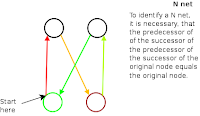
As before, I started with a relatively small net -- a hundred nodes and about 200 .. 250 edges. Which did it in less than half a minute, on a 400 MHz machine (single core CPU). Launching a 1000 nodes large test net with 2,500 to 5,000 edges, I learned it took about an hour. -- I became a bit scared because of that development, but then figured the reason for that slowness might be that it's just a 400 MHz machine only.
I put it onto the before mentioned 2000 MHz computer. -- The about 5000 edges got examined in less but three minutes. -- Phew!.
But I think, there are chances to speed up the approach, still. Anyone interested in improving the code or algorithm?
But, yes, sadly, I didn't check in the code yet, since I am after implementing detecting and replacing [the found] kind N networks. And the latter part I didn't figure out yet.
Updates: none so far
Virtual areas in a matrix? If you consider a non-zero cell of a matrix to be a spot of an area, a larger such area constitutes by adjacent spots (non-zero cells). I consider them being rectangular when they cover an area of at least 2 x 2 cells of the matrix, better: at least 2 x 3 or 3 x 2. A 2 x 3 area equals the W network (3 x 2 is the M network; W and M networks both are kind N networks). Fine, so far. But virtual?
There might be lines of adjacent spots within the matrix, but the lines might be away from another line of spots, i.e. not adjacently. But some rows or columns away. These lines, together, although being disjacent, can get considered to constitute an area -- a virtual. That's because the x and y values represent a node each, hence the non-zero cells within the matrix are edges. There's really no need that the node which was set up to be column x to be fixed at that position. Hence, the columns -- and rows -- of the matrix are freely swappable. In other words, we shift around the marked spots within the matrix to get a real area.

See the picture aside: There are blue, red and green marked cells. Obviously, the blue spots form an area, since they neighbour each other.
The lower part of the green area is a step more complicated: We could get the 2 x 3 area, if we'd ignored the upper part of the green, by simply swapping columns 4 and 1. To get the remainder of the green, we need to swap rows 2 and 5. Which, of course would disrupt the blue area.
However, we could note down the blue area first and swap for the green area afterwards,
The red area, then, is the most complex one, at first glance, but after swapping around a bit, it gets found as well -- yet rather simply.
As the non-zero cells within the matrix are edges, a 10 x 10 matrix as a whole could contain up to a hundred different edges, i.e. get and be densely filled.
But there's a restriction with the matrix, not visible in the diagram: The columns and the rows represent the same nodes. So, as the MOM graph allows no loops, less than half of the matrix may be filled, actually, -- the upper right half of the matrix less the diagonal from top left to bottom right. So, in reality, the matrix never gets really dense.
However, I implemented the approach -- and while it worked fine with a matrix as small as 10 x 10 or 20 x 20, when I launched examination of a 1000 x 1000 matrix I quickly became aware, that approach might be "a bit" slow: It took hours on a 2 GHz machine (single core x86 CPU). Actually, the necessary processing time increased exponentially. -- And a thousand nodes is really not that much. Really, not even worth to mention: Just think about the number of words being part of a common day's news feed.
Well, now I developed another approach of detecting kind N networks within a MOM network, doing it by considering the edges only. That, effectively, leaves out the white spaces of the matrix.

As before, I started with a relatively small net -- a hundred nodes and about 200 .. 250 edges. Which did it in less than half a minute, on a 400 MHz machine (single core CPU). Launching a 1000 nodes large test net with 2,500 to 5,000 edges, I learned it took about an hour. -- I became a bit scared because of that development, but then figured the reason for that slowness might be that it's just a 400 MHz machine only.
I put it onto the before mentioned 2000 MHz computer. -- The about 5000 edges got examined in less but three minutes. -- Phew!.
But I think, there are chances to speed up the approach, still. Anyone interested in improving the code or algorithm?
But, yes, sadly, I didn't check in the code yet, since I am after implementing detecting and replacing [the found] kind N networks. And the latter part I didn't figure out yet.
Updates: none so far
Thursday, August 09, 2007
How does a question get stored? Does an answer replace a question? How do we find out that there's a chance to get a question answered?
One day amidst my course of studies, I wondered about how questions (i.e. question texts) and answers might get stored in mind. That curiousity was the first step to the later Model of Meaning, nowadays also known as Content Representation model. I wondered whether an answer might replace a question one day:
To mention context together with a question applies meaning to the question. When the question gets answered, the anwer might accompany that meaning. -- Well, wenn the question is answered thoroughly, I think, the answer might replace the question.
Does that mean, that in mind the question gets stored as a placeholder for any upcoming answer? How long does any such placeholder [if it is such a one] hold that place before it gets replace [if it gets replaced at all] by the/an answer?
Or does mind set up any data node that tells "lack of information"? And the question gets generated instantly? -- And if so, does that generation take place when there's indeed a chance to get the question answered? But what might be the trigger for finding out that there's a chance to get the question answered?
Benefits of detecting and replacing kind N networks: revealing implied content
Added documentation to the sub-framework of detection of replacable partitial networks, and rewrote parts of initialization for a few classes. Actually, what I am talking here about is the kind N networks detection.
 Kind N networks, in the MOM terminology, are such ones of four or more nodes, two predecessors (cf. image: nodes A and B), two successors (nodes C and D), and each of the predecessors connected to each of the successors. That looks like a mixture of an "N" and an "X" character.
As the X often gets used to indicate something unknown, but here is not anything unknown, that kind of network got called the N network. -- Add a pair of successor and predecessor, and it still looks somewhat like that X-N mixture. As it features more but two base and two top points, we call it a pure kind N network: any MOM sub-network that consists of an equal number of predecessor and successor nodes (and wires all the predecessor to the successor nodes) is called a pure kind N network. Thus, the N network, of course, is also a pure kind N network.
Then, there are chances, a network features more successor nodes but predecessor ones. If the number of predecessor nodes is >= 2, that kind of net gets called a kind W network, because of its shape. -- It gets called the W network, if it sports only two predecessor and exactly three successor nodes.
 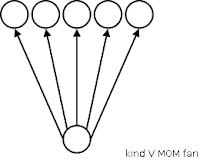 If a graph features only a single predecessor node, it's a kind V fan. Similar to the naming scheme for the W network, a kind V fan gets called the V fan, if its shape matches the letter: If it features a single predecessor and exactly two successor nodes.
Put upside down, we get a kind M network, the M network, a kind A fan and the A fan, resepectively.
Because kind W/M networks follow the pure kind N network approach by wiring each predecessor with each successor node, all together -- kind W, kind M and pure kind N networks get summarized under the generic "kind N network" label.
So, the efforts done were to detect any kind N networks within a larger MOM network. Why? -- The complete wiring of each predecessor node with each successor node results in a situation,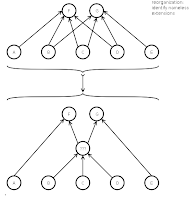 that the content of each successor node equals the content of all predecessor nodes together (plus the content of any separate predecessor nodes the successors don't share with their neighbours of that kind N network). The image aside shows it: Nodes F and G share the content of B, C and D. A becomes part of F only, so does E for G. -- That sharing of common predecessor nodes implies two things:
Now, part of it was rewritten and all of it documented. Now that sub-framework for kind N net detection needs to get spread into separate class files and put into a sub-directory or sub-directory hierarchy.
Updates: none so far
 Kind N networks, in the MOM terminology, are such ones of four or more nodes, two predecessors (cf. image: nodes A and B), two successors (nodes C and D), and each of the predecessors connected to each of the successors. That looks like a mixture of an "N" and an "X" character.
As the X often gets used to indicate something unknown, but here is not anything unknown, that kind of network got called the N network.
 -- Add a pair of successor and predecessor, and it still looks somewhat like that X-N mixture. As it features more but two base and two top points, we call it a pure kind N network: any MOM sub-network that consists of an equal number of predecessor and successor nodes (and wires all the predecessor to the successor nodes) is called a pure kind N network. Thus, the N network, of course, is also a pure kind N network.
Then, there are chances, a network features more successor nodes but predecessor ones.
 If the number of predecessor nodes is >= 2, that kind of net gets called a kind W network, because of its shape. -- It gets called the W network, if it sports only two predecessor and exactly three successor nodes.
  If a graph features only a single predecessor node, it's a kind V fan. Similar to the naming scheme for the W network, a kind V fan gets called the V fan, if its shape matches the letter: If it features a single predecessor and exactly two successor nodes.
Put upside down, we get a kind M network, the M network, a kind A fan and the A fan, resepectively.
Because kind W/M networks follow the pure kind N network approach by wiring each predecessor with each successor node, all together -- kind W, kind M and pure kind N networks get summarized under the generic "kind N network" label.
So, the efforts done were to detect any kind N networks within a larger MOM network. Why? -- The complete wiring of each predecessor node with each successor node results in a situation,
 that the content of each successor node equals the content of all predecessor nodes together (plus the content of any separate predecessor nodes the successors don't share with their neighbours of that kind N network). The image aside shows it: Nodes F and G share the content of B, C and D. A becomes part of F only, so does E for G. -- That sharing of common predecessor nodes implies two things:
 - First, as any MOM node represents the merged content of its predecessor nodes, we could replace the heavy wiring by adding a new node and wire link all predecessor nodes of the kind N network to that newly added node and it to all the successor nodes. That way the number of edges needed to administer could get reduced from a * b to only a + b.
- Second, as now it might be obvious, that wiring of all the predecessor nodes to each of the successor nodes was nothing different but an implication. A not explied (?)/explicited (?) notion. By adding the node, we make it explicit.
Now, part of it was rewritten and all of it documented. Now that sub-framework for kind N net detection needs to get spread into separate class files and put into a sub-directory or sub-directory hierarchy.
Updates: none so far
Tuesday, July 31, 2007
Finished a first piece of reorganization
Just finished: One core part of reorganization -- finding large replacable partitial networks. I figured, that might get me rid of those double feed news, as having this functionality available might enable me to sort news by topic. ... Which makes me ponder about wrapping this bit into a rails site. ;-)
Updates: none so far
Updates: none so far
Friday, July 27, 2007
chance for a MOM application: get old news filtered from RSS feeds
Development on the MOM SSC framework and especially implementing one core part of the reorganizer got lagged because I am still after getting a job (and other issues). Apparently, that search distracts more but actually having a job.
However, the time to read the feeds I defend. But there I found a problem -- too much interesting news and too many repetitions of the same topic. I survived one Apple keynote time, and I endured the Vista market introduction. But when there was another hype on the iPhone I begun feeling nagged.
Now, as the iPhone wave gets prolonged by iPhone hacks, and as noone can hid from that Harry Potter hype, I really get annoyed. -- As the Model of Meaning provides the logic to detect similarities, I want a tool that determines old news and variants of yet known news. Such as the latest iPhone hack or Potter p2p share.
Another way but looking up and dealing with the tags of feed entries, might be to take the words of any set of two or more articles and see for sets of words they share. A more brute-force (and less MOM way approach would be to take word neighbourhoods (word sequences) into consideration. -- On the other hand, the tool-to-be could use wordnet to include synonyms into 'consideration' when looking for similarities between texts.
For that reason, now I see how I can get through with the beforementioned reorganizer core -- the one that actually detects similarities for to save edges, i.e. storage -- logical by edges as well as "physically" by disk space.
Updates: 20070731: linked the word "lagged" to the last recent release posting
However, the time to read the feeds I defend. But there I found a problem -- too much interesting news and too many repetitions of the same topic. I survived one Apple keynote time, and I endured the Vista market introduction. But when there was another hype on the iPhone I begun feeling nagged.
Now, as the iPhone wave gets prolonged by iPhone hacks, and as noone can hid from that Harry Potter hype, I really get annoyed. -- As the Model of Meaning provides the logic to detect similarities, I want a tool that determines old news and variants of yet known news. Such as the latest iPhone hack or Potter p2p share.
Another way but looking up and dealing with the tags of feed entries, might be to take the words of any set of two or more articles and see for sets of words they share. A more brute-force (and less MOM way approach would be to take word neighbourhoods (word sequences) into consideration. -- On the other hand, the tool-to-be could use wordnet to include synonyms into 'consideration' when looking for similarities between texts.
For that reason, now I see how I can get through with the beforementioned reorganizer core -- the one that actually detects similarities for to save edges, i.e. storage -- logical by edges as well as "physically" by disk space.
Updates: 20070731: linked the word "lagged" to the last recent release posting
Friday, July 13, 2007
Positive hits in the "content representation" search results
Correct hits on the "content representation" term Google search (in opposite to any such hits that contained "content <something else but whitespace only, such as punctuation> representation"):
The above results I picked from pages 79 and 78 only -- and already learned a lession: It might make more sense to apply some kind of clustering here instead of walking through the list manually. Even the intellectual check whether there is anything in between of "content" and "representation" -- to filter out false hits --, can be done by software.
I'd like to learn the most-often used terms (besides of "content representation"), and, by help of that clustering/visualization, I want to get the chance to ignore obvious false hits.
That demands for using -- get hands on -- the Google API.
Updates: none so far
- Mining Web Documents for Unintended Information Revelation
- LHNCBC: Mansur Project - Anatomical Text to Images
- Data processing: presentation processing of document patents new
- Philippe Jost - LTS2
- nformation Sciences Institute - Research
- [PDF] Music notation/representation requirements for the protection of ...
- [PDF] Microsoft PowerPoint - Research_GET_STIC ASIE.ppt
- Informed Content Delivery Across Adaptive Overlay Networks
- Digital Television Applications
- [PDF] Abstract Model, 70–76 Accessibility characteristics, 262 Act, 217 ...
- [PS] Selecting Task-Relevant Sources for Just-in-Time Retrieval
- [Cc-uk] FW: IEE Events] The 2nd European Workshop on the ...
- [PDF] T R D R
- XML Pitstop : Largest Source of XML Examples on the Web
- ...
The above results I picked from pages 79 and 78 only -- and already learned a lession: It might make more sense to apply some kind of clustering here instead of walking through the list manually. Even the intellectual check whether there is anything in between of "content" and "representation" -- to filter out false hits --, can be done by software.
I'd like to learn the most-often used terms (besides of "content representation"), and, by help of that clustering/visualization, I want to get the chance to ignore obvious false hits.
That demands for using -- get hands on -- the Google API.
Updates: none so far
wanted: tag cloud for the other pages mentioning the term "content representation"
I'd like to learn what all these 91,900 search results related to content representation might be about. (Curiously, I wonder where I left the article directly pointing to that search result -- when it still were 88,900 "only".)
To learn that quickly, first I need to decide whether to see the pages manually or "mechanically". Then, I'd need to learn how to use the Google API to quickly get all the hits -- which actually end by page 78 which in fact is not 90 thousand plus search results but only a "small" number of only 788 hits.
However, since I'd like to redo this search every now and then again, and as I might like to do the search for sites like Cite Seer as well, it might be worth the effort to develop a small program which helps me in determining the content of all the pages. -- A tag cloud and toying around with precision and recall might contribute a bit to the visualized cloud. -- The cloud terms' sizes could visualize quantity in recall, while the precision might get indicated by color incoding, e.g. blue .. green .. yellow .. orange .. red, like on maps, where high precision might get indicated by red and low precision by blue.
There's a tag cloud generator available in Debian's share of Perl libraries. I already modified it, and it's available on demand. -- However, I'd prefer to have any place in the web to put my version to. Any repository out there for that library?
Updates: none so far
To learn that quickly, first I need to decide whether to see the pages manually or "mechanically". Then, I'd need to learn how to use the Google API to quickly get all the hits -- which actually end by page 78 which in fact is not 90 thousand plus search results but only a "small" number of only 788 hits.
However, since I'd like to redo this search every now and then again, and as I might like to do the search for sites like Cite Seer as well, it might be worth the effort to develop a small program which helps me in determining the content of all the pages. -- A tag cloud and toying around with precision and recall might contribute a bit to the visualized cloud. -- The cloud terms' sizes could visualize quantity in recall, while the precision might get indicated by color incoding, e.g. blue .. green .. yellow .. orange .. red, like on maps, where high precision might get indicated by red and low precision by blue.
There's a tag cloud generator available in Debian's share of Perl libraries. I already modified it, and it's available on demand. -- However, I'd prefer to have any place in the web to put my version to. Any repository out there for that library?
Updates: none so far
A hunger for analysis and play(ing), after cramming data into one's memory
After having speed-read a book of project management, my mind starves for any analytical task to do. Not necessarily of the stuff just read/learnt but of anything.
Might it be possible that being confronted with a bold set of news results in a bold number of newly available neurons -- that kind-of want/need to bee stored somewhere, get wired in somewhere/any better in case they' are already wired in, somewhat? Does that task urge, since it might feel unpleasant otherwise?
— Indeed, the motivation behind that hunger for analysis, in fact, might be to give (any) thing a trial, to experiment.
Updates: none so far
Might it be possible that being confronted with a bold set of news results in a bold number of newly available neurons -- that kind-of want/need to bee stored somewhere, get wired in somewhere/any better in case they' are already wired in, somewhat? Does that task urge, since it might feel unpleasant otherwise?
— Indeed, the motivation behind that hunger for analysis, in fact, might be to give (any) thing a trial, to experiment.
Updates: none so far
Subscribe to:
Posts (Atom)

