Right now, I am using my secondary workplace PC. At this one, I am used to use it one-handedly. And let the auto-completion kick in.
In a recent blog posting somewhere else, I was discussing lectures, lecturers, discussing as a topic, and the next issue I moved to was seminars. Intuitively, I expected, the auto-completion would kick in and offer "seminars" -- which it didn't.
I pondered whether to file a feature request, suggesting to background-use a thesaurus -- a word-processing one, not necessarily a real one -- to predict the words one might most-likely use soon. -- Then, I nticed, traditional term ordering systems like e.g. thesauri might have a hard time to do so; even more the programmers who actually should implement such kind of tool... well, on the second glance, maybe brute force could help there, and as a text is a relatively small amount of data (and vocabularies even more small), might be doable, easily to implement.
The brute force approach could pick up, stem the words of the text, then follow all the relation edges of a term to its set of neighbours, collect them, order them by alphabet, consider them like the words appearing really i the text: offer them for auto-completion where it looks appropriately.
On the other hand, a MOM approach might be to consider the words of the already typed-in text, step back a step, see the features of the items of the terms, count which other item(s) count the most features the until-now mentioned ones feature too. That way, we additionally would get a ranking of probability of upcoming terms. ... I'd do that myself, but the issue on tasks like this remans the old one: Where to get such interrelated collections of words in a reasonable amount and for reasonable .. no cost at all?
Updates: none so far
Thursday, October 25, 2007


Tuesday, October 23, 2007
adjusting the direction of this blog: blogging on current neuro issues
I've been working on the Model of Meaning "ideas conglomerate" since more than seven years now. The first question I count to be part of that system of ideas I asked in summer 2000, during a more or less boring lesson on some economics subject.
Unfortunately, I picked up the issue before I became introduced into the methodology of working scientifically. So what I figured out, what I read, what I observed, perceived went into a big mix-up. Which brought me into some trouble: Since I apprehend several issues of behaviour, perception, neurology/thinking each a while before someone else published their papers on the issue -- I read about them in a popular science magazine -- I strongly believe, I am right with my course throught the complex. However, I started without sticking to scientific methods, but I figured out things. -- To gain the reputation ("credits"), I thought I should get for that work, I had to put the whole building of what I've figured out onto a new, stable, scientific foundation. But the same time, I already felt unable to differenciate between what I figured out by myself and what I learnt from any external source: What someone was telling might or might not imply what I figured out already. How to make sure, they and me meant, implied the same?
To prove, I were right, I thought the better opportunity would be to just implement the whole idea as a piece of software -- that is what you know by MOM today.
However, as I am unemployed currently, I became really distracted from the MOM project. And involved in more professional blogging. Which continuously carries along the question, how to increase one's reputation.
Now, I was reading a posting of a not so reliable popular science [kind of] blog on sleep deprivation, how it'd affect rational thinking. As sleep is a topic I touched by MOM several times, I was interested in verifying whether or not the "blog" was re-narrating correctly. As CiteSeer seems to be down, currently, I launched Google Scholar with a demand for articles of Seung-Schik Yoo for 2007. (In the hope to get the article.) However, accidentally, I found A deficit in the ability to form new human memories without sleep by the same person (co-author), published in February 2007. Which nudged me even further to my insights gained by MOM. -- As I am currently experiencing a regular visitor from Korea on this MOM blog, I thought it might be worth a shot to start just blogging about MOM -- even if I don't have any scientific reputation in that field of topic.
That's why you are reading this posting here.
The impulse was, I might gain and convince some audience, maybe even gain some reputation in this field of topic, despite not any scientific one. However, I think, it might become some fun to comment on what's going on in this area, even without any scientific degree here.
Additionally, I am interested in perception, usability, comprehensibility, everything that has anything to do with mind and memory. But one thing, I am not interested in. That is artificial intelligence. When I touched intelligence any time in the past, it was a by-product at all.
Whatever. Let's see whether or not it'd actually blog on it...
Updates: none so far
Unfortunately, I picked up the issue before I became introduced into the methodology of working scientifically. So what I figured out, what I read, what I observed, perceived went into a big mix-up. Which brought me into some trouble: Since I apprehend several issues of behaviour, perception, neurology/thinking each a while before someone else published their papers on the issue -- I read about them in a popular science magazine -- I strongly believe, I am right with my course throught the complex. However, I started without sticking to scientific methods, but I figured out things. -- To gain the reputation ("credits"), I thought I should get for that work, I had to put the whole building of what I've figured out onto a new, stable, scientific foundation. But the same time, I already felt unable to differenciate between what I figured out by myself and what I learnt from any external source: What someone was telling might or might not imply what I figured out already. How to make sure, they and me meant, implied the same?
To prove, I were right, I thought the better opportunity would be to just implement the whole idea as a piece of software -- that is what you know by MOM today.
However, as I am unemployed currently, I became really distracted from the MOM project. And involved in more professional blogging. Which continuously carries along the question, how to increase one's reputation.
Now, I was reading a posting of a not so reliable popular science [kind of] blog on sleep deprivation, how it'd affect rational thinking. As sleep is a topic I touched by MOM several times, I was interested in verifying whether or not the "blog" was re-narrating correctly. As CiteSeer seems to be down, currently, I launched Google Scholar with a demand for articles of Seung-Schik Yoo for 2007. (In the hope to get the article.) However, accidentally, I found A deficit in the ability to form new human memories without sleep by the same person (co-author), published in February 2007. Which nudged me even further to my insights gained by MOM. -- As I am currently experiencing a regular visitor from Korea on this MOM blog, I thought it might be worth a shot to start just blogging about MOM -- even if I don't have any scientific reputation in that field of topic.
That's why you are reading this posting here.
The impulse was, I might gain and convince some audience, maybe even gain some reputation in this field of topic, despite not any scientific one. However, I think, it might become some fun to comment on what's going on in this area, even without any scientific degree here.
Additionally, I am interested in perception, usability, comprehensibility, everything that has anything to do with mind and memory. But one thing, I am not interested in. That is artificial intelligence. When I touched intelligence any time in the past, it was a by-product at all.
Whatever. Let's see whether or not it'd actually blog on it...
Updates: none so far
Tuesday, October 09, 2007
on using tags in file system
Stumbled upon, but not yet read. It`s a 2005 blog entry of anyone on using tags in file systems.
Updates: none so far
Updates: none so far
Monday, August 20, 2007
removed: Sidebar element "Objective"
Objective
Common quality of today's information technology, in an aim to become able to identify items, is to mark up every single item. – The Model of Meaning heads to build the foundation to manage-without any such markup.
The approach is about content representation in the literal sense of the term.
Updates: none so far
Common quality of today's information technology, in an aim to become able to identify items, is to mark up every single item. – The Model of Meaning heads to build the foundation to manage-without any such markup.
The approach is about content representation in the literal sense of the term.
Updates: none so far
Friday, August 10, 2007
Search results on graph algorithms
I asked before, whether or not someone might be interested in improving the kind N network detection algorithm. -- Well, I figured, I "shot first, asked then", figuratively, implemented the approach before asking Google about the issue. Hm. Foolish.
But, as I grasped the idea now, that's a chance for further improvement of the detection approach. However, I want to get that baby implemented once in complete before I go into any source improving. Hence, I keep the offer: If you're interested in diving into MOM, the source, want to improve it, its source, or especially the kind N network detection, please let me know. I'd be curiously to hear from you.
Updates: none so far
But, as I grasped the idea now, that's a chance for further improvement of the detection approach. However, I want to get that baby implemented once in complete before I go into any source improving. Hence, I keep the offer: If you're interested in diving into MOM, the source, want to improve it, its source, or especially the kind N network detection, please let me know. I'd be curiously to hear from you.
Updates: none so far
Detecting kind N networks: Speed comparison of matrix and graph based approaches
The approach of determining kind N networks I took a year before -- when I was still using Perl and drafting the approach by functional programming [which later became hardly to comprehend] -- was to mark all the edges into a matrix and detect rectangular, non-intersecting, virtual areas there.
Virtual areas in a matrix? If you consider a non-zero cell of a matrix to be a spot of an area, a larger such area constitutes by adjacent spots (non-zero cells). I consider them being rectangular when they cover an area of at least 2 x 2 cells of the matrix, better: at least 2 x 3 or 3 x 2. A 2 x 3 area equals the W network (3 x 2 is the M network; W and M networks both are kind N networks). Fine, so far. But virtual?
There might be lines of adjacent spots within the matrix, but the lines might be away from another line of spots, i.e. not adjacently. But some rows or columns away. These lines, together, although being disjacent, can get considered to constitute an area -- a virtual. That's because the x and y values represent a node each, hence the non-zero cells within the matrix are edges. There's really no need that the node which was set up to be column x to be fixed at that position. Hence, the columns -- and rows -- of the matrix are freely swappable. In other words, we shift around the marked spots within the matrix to get a real area.
See the picture aside: There are blue, red and green marked cells. Obviously, the blue spots form an area, since they neighbour each other.
The lower part of the green area is a step more complicated: We could get the 2 x 3 area, if we'd ignored the upper part of the green, by simply swapping columns 4 and 1. To get the remainder of the green, we need to swap rows 2 and 5. Which, of course would disrupt the blue area.
However, we could note down the blue area first and swap for the green area afterwards,
The red area, then, is the most complex one, at first glance, but after swapping around a bit, it gets found as well -- yet rather simply.
As the non-zero cells within the matrix are edges, a 10 x 10 matrix as a whole could contain up to a hundred different edges, i.e. get and be densely filled.
But there's a restriction with the matrix, not visible in the diagram: The columns and the rows represent the same nodes. So, as the MOM graph allows no loops, less than half of the matrix may be filled, actually, -- the upper right half of the matrix less the diagonal from top left to bottom right. So, in reality, the matrix never gets really dense.
However, I implemented the approach -- and while it worked fine with a matrix as small as 10 x 10 or 20 x 20, when I launched examination of a 1000 x 1000 matrix I quickly became aware, that approach might be "a bit" slow: It took hours on a 2 GHz machine (single core x86 CPU). Actually, the necessary processing time increased exponentially. -- And a thousand nodes is really not that much. Really, not even worth to mention: Just think about the number of words being part of a common day's news feed.
Well, now I developed another approach of detecting kind N networks within a MOM network, doing it by considering the edges only. That, effectively, leaves out the white spaces of the matrix.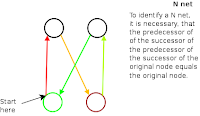
As before, I started with a relatively small net -- a hundred nodes and about 200 .. 250 edges. Which did it in less than half a minute, on a 400 MHz machine (single core CPU). Launching a 1000 nodes large test net with 2,500 to 5,000 edges, I learned it took about an hour. -- I became a bit scared because of that development, but then figured the reason for that slowness might be that it's just a 400 MHz machine only.
I put it onto the before mentioned 2000 MHz computer. -- The about 5000 edges got examined in less but three minutes. -- Phew!.
But I think, there are chances to speed up the approach, still. Anyone interested in improving the code or algorithm?
But, yes, sadly, I didn't check in the code yet, since I am after implementing detecting and replacing [the found] kind N networks. And the latter part I didn't figure out yet.
Updates: none so far
Virtual areas in a matrix? If you consider a non-zero cell of a matrix to be a spot of an area, a larger such area constitutes by adjacent spots (non-zero cells). I consider them being rectangular when they cover an area of at least 2 x 2 cells of the matrix, better: at least 2 x 3 or 3 x 2. A 2 x 3 area equals the W network (3 x 2 is the M network; W and M networks both are kind N networks). Fine, so far. But virtual?
There might be lines of adjacent spots within the matrix, but the lines might be away from another line of spots, i.e. not adjacently. But some rows or columns away. These lines, together, although being disjacent, can get considered to constitute an area -- a virtual. That's because the x and y values represent a node each, hence the non-zero cells within the matrix are edges. There's really no need that the node which was set up to be column x to be fixed at that position. Hence, the columns -- and rows -- of the matrix are freely swappable. In other words, we shift around the marked spots within the matrix to get a real area.

See the picture aside: There are blue, red and green marked cells. Obviously, the blue spots form an area, since they neighbour each other.
The lower part of the green area is a step more complicated: We could get the 2 x 3 area, if we'd ignored the upper part of the green, by simply swapping columns 4 and 1. To get the remainder of the green, we need to swap rows 2 and 5. Which, of course would disrupt the blue area.
However, we could note down the blue area first and swap for the green area afterwards,
The red area, then, is the most complex one, at first glance, but after swapping around a bit, it gets found as well -- yet rather simply.
As the non-zero cells within the matrix are edges, a 10 x 10 matrix as a whole could contain up to a hundred different edges, i.e. get and be densely filled.
But there's a restriction with the matrix, not visible in the diagram: The columns and the rows represent the same nodes. So, as the MOM graph allows no loops, less than half of the matrix may be filled, actually, -- the upper right half of the matrix less the diagonal from top left to bottom right. So, in reality, the matrix never gets really dense.
However, I implemented the approach -- and while it worked fine with a matrix as small as 10 x 10 or 20 x 20, when I launched examination of a 1000 x 1000 matrix I quickly became aware, that approach might be "a bit" slow: It took hours on a 2 GHz machine (single core x86 CPU). Actually, the necessary processing time increased exponentially. -- And a thousand nodes is really not that much. Really, not even worth to mention: Just think about the number of words being part of a common day's news feed.
Well, now I developed another approach of detecting kind N networks within a MOM network, doing it by considering the edges only. That, effectively, leaves out the white spaces of the matrix.

As before, I started with a relatively small net -- a hundred nodes and about 200 .. 250 edges. Which did it in less than half a minute, on a 400 MHz machine (single core CPU). Launching a 1000 nodes large test net with 2,500 to 5,000 edges, I learned it took about an hour. -- I became a bit scared because of that development, but then figured the reason for that slowness might be that it's just a 400 MHz machine only.
I put it onto the before mentioned 2000 MHz computer. -- The about 5000 edges got examined in less but three minutes. -- Phew!.
But I think, there are chances to speed up the approach, still. Anyone interested in improving the code or algorithm?
But, yes, sadly, I didn't check in the code yet, since I am after implementing detecting and replacing [the found] kind N networks. And the latter part I didn't figure out yet.
Updates: none so far
Thursday, August 09, 2007
How does a question get stored? Does an answer replace a question? How do we find out that there's a chance to get a question answered?
One day amidst my course of studies, I wondered about how questions (i.e. question texts) and answers might get stored in mind. That curiousity was the first step to the later Model of Meaning, nowadays also known as Content Representation model. I wondered whether an answer might replace a question one day:
To mention context together with a question applies meaning to the question. When the question gets answered, the anwer might accompany that meaning. -- Well, wenn the question is answered thoroughly, I think, the answer might replace the question.
Does that mean, that in mind the question gets stored as a placeholder for any upcoming answer? How long does any such placeholder [if it is such a one] hold that place before it gets replace [if it gets replaced at all] by the/an answer?
Or does mind set up any data node that tells "lack of information"? And the question gets generated instantly? -- And if so, does that generation take place when there's indeed a chance to get the question answered? But what might be the trigger for finding out that there's a chance to get the question answered?
Benefits of detecting and replacing kind N networks: revealing implied content
Added documentation to the sub-framework of detection of replacable partitial networks, and rewrote parts of initialization for a few classes. Actually, what I am talking here about is the kind N networks detection.
 Kind N networks, in the MOM terminology, are such ones of four or more nodes, two predecessors (cf. image: nodes A and B), two successors (nodes C and D), and each of the predecessors connected to each of the successors. That looks like a mixture of an "N" and an "X" character.
As the X often gets used to indicate something unknown, but here is not anything unknown, that kind of network got called the N network. -- Add a pair of successor and predecessor, and it still looks somewhat like that X-N mixture. As it features more but two base and two top points, we call it a pure kind N network: any MOM sub-network that consists of an equal number of predecessor and successor nodes (and wires all the predecessor to the successor nodes) is called a pure kind N network. Thus, the N network, of course, is also a pure kind N network.
Then, there are chances, a network features more successor nodes but predecessor ones. If the number of predecessor nodes is >= 2, that kind of net gets called a kind W network, because of its shape. -- It gets called the W network, if it sports only two predecessor and exactly three successor nodes.
 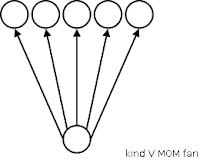 If a graph features only a single predecessor node, it's a kind V fan. Similar to the naming scheme for the W network, a kind V fan gets called the V fan, if its shape matches the letter: If it features a single predecessor and exactly two successor nodes.
Put upside down, we get a kind M network, the M network, a kind A fan and the A fan, resepectively.
Because kind W/M networks follow the pure kind N network approach by wiring each predecessor with each successor node, all together -- kind W, kind M and pure kind N networks get summarized under the generic "kind N network" label.
So, the efforts done were to detect any kind N networks within a larger MOM network. Why? -- The complete wiring of each predecessor node with each successor node results in a situation,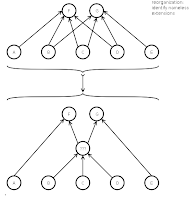 that the content of each successor node equals the content of all predecessor nodes together (plus the content of any separate predecessor nodes the successors don't share with their neighbours of that kind N network). The image aside shows it: Nodes F and G share the content of B, C and D. A becomes part of F only, so does E for G. -- That sharing of common predecessor nodes implies two things:
Now, part of it was rewritten and all of it documented. Now that sub-framework for kind N net detection needs to get spread into separate class files and put into a sub-directory or sub-directory hierarchy.
Updates: none so far
 Kind N networks, in the MOM terminology, are such ones of four or more nodes, two predecessors (cf. image: nodes A and B), two successors (nodes C and D), and each of the predecessors connected to each of the successors. That looks like a mixture of an "N" and an "X" character.
As the X often gets used to indicate something unknown, but here is not anything unknown, that kind of network got called the N network.
 -- Add a pair of successor and predecessor, and it still looks somewhat like that X-N mixture. As it features more but two base and two top points, we call it a pure kind N network: any MOM sub-network that consists of an equal number of predecessor and successor nodes (and wires all the predecessor to the successor nodes) is called a pure kind N network. Thus, the N network, of course, is also a pure kind N network.
Then, there are chances, a network features more successor nodes but predecessor ones.
 If the number of predecessor nodes is >= 2, that kind of net gets called a kind W network, because of its shape. -- It gets called the W network, if it sports only two predecessor and exactly three successor nodes.
  If a graph features only a single predecessor node, it's a kind V fan. Similar to the naming scheme for the W network, a kind V fan gets called the V fan, if its shape matches the letter: If it features a single predecessor and exactly two successor nodes.
Put upside down, we get a kind M network, the M network, a kind A fan and the A fan, resepectively.
Because kind W/M networks follow the pure kind N network approach by wiring each predecessor with each successor node, all together -- kind W, kind M and pure kind N networks get summarized under the generic "kind N network" label.
So, the efforts done were to detect any kind N networks within a larger MOM network. Why? -- The complete wiring of each predecessor node with each successor node results in a situation,
 that the content of each successor node equals the content of all predecessor nodes together (plus the content of any separate predecessor nodes the successors don't share with their neighbours of that kind N network). The image aside shows it: Nodes F and G share the content of B, C and D. A becomes part of F only, so does E for G. -- That sharing of common predecessor nodes implies two things:
 - First, as any MOM node represents the merged content of its predecessor nodes, we could replace the heavy wiring by adding a new node and wire link all predecessor nodes of the kind N network to that newly added node and it to all the successor nodes. That way the number of edges needed to administer could get reduced from a * b to only a + b.
- Second, as now it might be obvious, that wiring of all the predecessor nodes to each of the successor nodes was nothing different but an implication. A not explied (?)/explicited (?) notion. By adding the node, we make it explicit.
Now, part of it was rewritten and all of it documented. Now that sub-framework for kind N net detection needs to get spread into separate class files and put into a sub-directory or sub-directory hierarchy.
Updates: none so far
Tuesday, July 31, 2007
Finished a first piece of reorganization
Just finished: One core part of reorganization -- finding large replacable partitial networks. I figured, that might get me rid of those double feed news, as having this functionality available might enable me to sort news by topic. ... Which makes me ponder about wrapping this bit into a rails site. ;-)
Updates: none so far
Updates: none so far
Friday, July 27, 2007
chance for a MOM application: get old news filtered from RSS feeds
Development on the MOM SSC framework and especially implementing one core part of the reorganizer got lagged because I am still after getting a job (and other issues). Apparently, that search distracts more but actually having a job.
However, the time to read the feeds I defend. But there I found a problem -- too much interesting news and too many repetitions of the same topic. I survived one Apple keynote time, and I endured the Vista market introduction. But when there was another hype on the iPhone I begun feeling nagged.
Now, as the iPhone wave gets prolonged by iPhone hacks, and as noone can hid from that Harry Potter hype, I really get annoyed. -- As the Model of Meaning provides the logic to detect similarities, I want a tool that determines old news and variants of yet known news. Such as the latest iPhone hack or Potter p2p share.
Another way but looking up and dealing with the tags of feed entries, might be to take the words of any set of two or more articles and see for sets of words they share. A more brute-force (and less MOM way approach would be to take word neighbourhoods (word sequences) into consideration. -- On the other hand, the tool-to-be could use wordnet to include synonyms into 'consideration' when looking for similarities between texts.
For that reason, now I see how I can get through with the beforementioned reorganizer core -- the one that actually detects similarities for to save edges, i.e. storage -- logical by edges as well as "physically" by disk space.
Updates: 20070731: linked the word "lagged" to the last recent release posting
However, the time to read the feeds I defend. But there I found a problem -- too much interesting news and too many repetitions of the same topic. I survived one Apple keynote time, and I endured the Vista market introduction. But when there was another hype on the iPhone I begun feeling nagged.
Now, as the iPhone wave gets prolonged by iPhone hacks, and as noone can hid from that Harry Potter hype, I really get annoyed. -- As the Model of Meaning provides the logic to detect similarities, I want a tool that determines old news and variants of yet known news. Such as the latest iPhone hack or Potter p2p share.
Another way but looking up and dealing with the tags of feed entries, might be to take the words of any set of two or more articles and see for sets of words they share. A more brute-force (and less MOM way approach would be to take word neighbourhoods (word sequences) into consideration. -- On the other hand, the tool-to-be could use wordnet to include synonyms into 'consideration' when looking for similarities between texts.
For that reason, now I see how I can get through with the beforementioned reorganizer core -- the one that actually detects similarities for to save edges, i.e. storage -- logical by edges as well as "physically" by disk space.
Updates: 20070731: linked the word "lagged" to the last recent release posting
Friday, July 13, 2007
Positive hits in the "content representation" search results
Correct hits on the "content representation" term Google search (in opposite to any such hits that contained "content <something else but whitespace only, such as punctuation> representation"):
The above results I picked from pages 79 and 78 only -- and already learned a lession: It might make more sense to apply some kind of clustering here instead of walking through the list manually. Even the intellectual check whether there is anything in between of "content" and "representation" -- to filter out false hits --, can be done by software.
I'd like to learn the most-often used terms (besides of "content representation"), and, by help of that clustering/visualization, I want to get the chance to ignore obvious false hits.
That demands for using -- get hands on -- the Google API.
Updates: none so far
- Mining Web Documents for Unintended Information Revelation
- LHNCBC: Mansur Project - Anatomical Text to Images
- Data processing: presentation processing of document patents new
- Philippe Jost - LTS2
- nformation Sciences Institute - Research
- [PDF] Music notation/representation requirements for the protection of ...
- [PDF] Microsoft PowerPoint - Research_GET_STIC ASIE.ppt
- Informed Content Delivery Across Adaptive Overlay Networks
- Digital Television Applications
- [PDF] Abstract Model, 70–76 Accessibility characteristics, 262 Act, 217 ...
- [PS] Selecting Task-Relevant Sources for Just-in-Time Retrieval
- [Cc-uk] FW: IEE Events] The 2nd European Workshop on the ...
- [PDF] T R D R
- XML Pitstop : Largest Source of XML Examples on the Web
- ...
The above results I picked from pages 79 and 78 only -- and already learned a lession: It might make more sense to apply some kind of clustering here instead of walking through the list manually. Even the intellectual check whether there is anything in between of "content" and "representation" -- to filter out false hits --, can be done by software.
I'd like to learn the most-often used terms (besides of "content representation"), and, by help of that clustering/visualization, I want to get the chance to ignore obvious false hits.
That demands for using -- get hands on -- the Google API.
Updates: none so far
wanted: tag cloud for the other pages mentioning the term "content representation"
I'd like to learn what all these 91,900 search results related to content representation might be about. (Curiously, I wonder where I left the article directly pointing to that search result -- when it still were 88,900 "only".)
To learn that quickly, first I need to decide whether to see the pages manually or "mechanically". Then, I'd need to learn how to use the Google API to quickly get all the hits -- which actually end by page 78 which in fact is not 90 thousand plus search results but only a "small" number of only 788 hits.
However, since I'd like to redo this search every now and then again, and as I might like to do the search for sites like Cite Seer as well, it might be worth the effort to develop a small program which helps me in determining the content of all the pages. -- A tag cloud and toying around with precision and recall might contribute a bit to the visualized cloud. -- The cloud terms' sizes could visualize quantity in recall, while the precision might get indicated by color incoding, e.g. blue .. green .. yellow .. orange .. red, like on maps, where high precision might get indicated by red and low precision by blue.
There's a tag cloud generator available in Debian's share of Perl libraries. I already modified it, and it's available on demand. -- However, I'd prefer to have any place in the web to put my version to. Any repository out there for that library?
Updates: none so far
To learn that quickly, first I need to decide whether to see the pages manually or "mechanically". Then, I'd need to learn how to use the Google API to quickly get all the hits -- which actually end by page 78 which in fact is not 90 thousand plus search results but only a "small" number of only 788 hits.
However, since I'd like to redo this search every now and then again, and as I might like to do the search for sites like Cite Seer as well, it might be worth the effort to develop a small program which helps me in determining the content of all the pages. -- A tag cloud and toying around with precision and recall might contribute a bit to the visualized cloud. -- The cloud terms' sizes could visualize quantity in recall, while the precision might get indicated by color incoding, e.g. blue .. green .. yellow .. orange .. red, like on maps, where high precision might get indicated by red and low precision by blue.
There's a tag cloud generator available in Debian's share of Perl libraries. I already modified it, and it's available on demand. -- However, I'd prefer to have any place in the web to put my version to. Any repository out there for that library?
Updates: none so far
A hunger for analysis and play(ing), after cramming data into one's memory
After having speed-read a book of project management, my mind starves for any analytical task to do. Not necessarily of the stuff just read/learnt but of anything.
Might it be possible that being confronted with a bold set of news results in a bold number of newly available neurons -- that kind-of want/need to bee stored somewhere, get wired in somewhere/any better in case they' are already wired in, somewhat? Does that task urge, since it might feel unpleasant otherwise?
— Indeed, the motivation behind that hunger for analysis, in fact, might be to give (any) thing a trial, to experiment.
Updates: none so far
Might it be possible that being confronted with a bold set of news results in a bold number of newly available neurons -- that kind-of want/need to bee stored somewhere, get wired in somewhere/any better in case they' are already wired in, somewhat? Does that task urge, since it might feel unpleasant otherwise?
— Indeed, the motivation behind that hunger for analysis, in fact, might be to give (any) thing a trial, to experiment.
Updates: none so far
Thursday, July 12, 2007
Every beginning is hard.
The interesting question about "Every beginning is hard." is: Why? -- Not: For what reason, but by what origin? By what cause? What, on a neurologic basis is it that makes the beginnings so hard? Is there a way to overcome the beginnings to be hard, any way?
Updates: none so far
Updates: none so far
Sunday, July 01, 2007
other models of meaning
Maybe worth a skim: Search results on 'Model of Meaning'. ('Content Representation with a Twist' didn't find anything so far, neither on Google, nor on Yahoo. Although Yahoo's crawler visited the MOM development project page over at gna.org.)
Updates: none so far
Updates: none so far
Friday, June 29, 2007
New release of MOM SSC
New version is out!
Updates: none so far
- Now with test cases in place for all classes of the framework,
- heavily reworked HandledSet class and
- documentation for HandledSet too -- with a peek to the principles of reorganization.
Updates: none so far
Thursday, June 28, 2007
Why Do I Approach Developing MOM The Way Visible By MOM SSC?
The MOM Simple Set Core (MOM SSC) is the most recent implementation of MOM. MOM is a trinity of research, development and a project driving both of them ahead. In core, MOM is the Model of Meaning plus research based on that model, aiming at representing every kind of content bare of words and tagging, only based on graphs and bare input sensors, such as 'light given', 'oxygene here', 'soft ground'. -- However, since 'there is a red light under that passenger seat, calmly blinking' is a bit more complex content, and that content is not yet developed by graph, currently MOM accepts crutches -- labels or pieces of software that signal a certain event being given, e.g 'web browser cannot render that page correctly'. As MOM improves, such crutches shall get replaced by the more flexible (and error resistant) representation of content as offered by MOM.
There are several promised benefits of that. Getting content available without words implies the the chance to render content to any language of the world. Getting there without tagging implies the chance that the machine knows of the content represented -- instead of just dealing with it but remaining unaware of what it means. That in turn implies the chance to load content ("knowledge") into any sort of machines, such as traffic lights or vacuum cleaners or cars. Whereby to load the knowledge might be much a bit quicker but needing to train any sort of neuronal network AI. -- MOM is not after implementing any sorts of artificial intelligence but heads for getting the content available. Call it a [content-addressable] memory.
That error resistant representation of content beforementioned originates from another core part of MOM, the recognition. -- Yes, that's right. MOM found recognition to be a part of memory, not of any sorts of intelligence. It's an automatic process which, however, might be supportable by training [link: "is it learning?"]: weighting the graph's edges. [It's clear to me that humans can improve their recognition, but I am not sure whether the causes of learning equal those of improving the recognition abilities of a MOM net, hence the differentiation.] Core of MOM's recognition and cause for its error resistance is that while the MOM net defines every possible feature of an item, for recognition not every such one must be given, only a few. -- Which, by the way, matches a claim recently posted by Chris Chatham: Only a few of the features of a known item result in a correct recognition of that item because there are only the yet known items out there: To discern all the items being similar, you don't need that many different features. But wait the day you encounter an in fact new item! -- You'd get it wrong, in any case. Remember the days you were familar to dogs as the only kind of pet animals? Then, encountering the first pet cat, you likely named it 'dog', din't you? Same so for any kind of flip pictures, like the one you can either see a beautiful young woman in or a rather old one. -- To get back to Chatham: On the issue of change blindness he claimed "[...] the brain is 'offloading' its memory requirements to the environment in which it exists: why bother remembering the location of objects when a quick glance will suffice?"
Along with research, MOM is a project of development. I am used to program, hence cast MOM into software is the most clear way to go. MOM, casted to software, allows for verifying the model. Also, over time, a full implementation of MOM might result, hence achieve to get handy all the chances MOM offers.
For example, the MOM Simple Set Core (MOM SSC) originally was only after implementing the MOM net, i.e. the functionality to maintain (parts of) a MOM net in computer memory (RAM). That's overcome now. Now, going further ahead, MOM SSC aims at implementing the reorganizer. That's a share of MOM which shrinks the graph by kepping the same content -- yet even revealing content which was only implicit beforehand.
Former versions of MOM parts were implemented using Perl. For reasons of readability, for MOM SSC, Ruby was chosen. Since the theoretical work on the reorganizer it was clear, the reorganizer modifies the MOM net, hence challenges the strengths of the recognizer. To get able to make the recognizer perform well even on reorganized MOM nets, I now begun to implement the reorganizer. Having it in place, research on the recognition might go into depth. Especially since having a reorganizer in place implies to get enabled to automatically test quality of recognition: Recognition on the reorganized net should provide the same results as recognition performed on the original net. Fine part is, neither reorganization nor recognition need any labels for the nodes (i.e.: no mark-up/tagging).
Upcoming milestone of the MOM SSC sub-project might be to implement the core of the reorganizer, accompanied by full duck typing approach for the MOM SSC classes, or/and by fixing all the chances for improvement, which accumulated over time since the beginnings of MOM SSC. -- Core of the reorganizer is to detect and replace sub-networks of the MOM graph that occupy (far) more nodes/edges than necessary to represent a piece of content. The replace would be to reduce these sub-networks to just as many nodes/edges as actually needed to represent the content.
Updates: none so far
There are several promised benefits of that. Getting content available without words implies the the chance to render content to any language of the world. Getting there without tagging implies the chance that the machine knows of the content represented -- instead of just dealing with it but remaining unaware of what it means. That in turn implies the chance to load content ("knowledge") into any sort of machines, such as traffic lights or vacuum cleaners or cars. Whereby to load the knowledge might be much a bit quicker but needing to train any sort of neuronal network AI. -- MOM is not after implementing any sorts of artificial intelligence but heads for getting the content available. Call it a [content-addressable] memory.
That error resistant representation of content beforementioned originates from another core part of MOM, the recognition. -- Yes, that's right. MOM found recognition to be a part of memory, not of any sorts of intelligence. It's an automatic process which, however, might be supportable by training [link: "is it learning?"]: weighting the graph's edges. [It's clear to me that humans can improve their recognition, but I am not sure whether the causes of learning equal those of improving the recognition abilities of a MOM net, hence the differentiation.] Core of MOM's recognition and cause for its error resistance is that while the MOM net defines every possible feature of an item, for recognition not every such one must be given, only a few. -- Which, by the way, matches a claim recently posted by Chris Chatham: Only a few of the features of a known item result in a correct recognition of that item because there are only the yet known items out there: To discern all the items being similar, you don't need that many different features. But wait the day you encounter an in fact new item! -- You'd get it wrong, in any case. Remember the days you were familar to dogs as the only kind of pet animals? Then, encountering the first pet cat, you likely named it 'dog', din't you? Same so for any kind of flip pictures, like the one you can either see a beautiful young woman in or a rather old one. -- To get back to Chatham: On the issue of change blindness he claimed "[...] the brain is 'offloading' its memory requirements to the environment in which it exists: why bother remembering the location of objects when a quick glance will suffice?"
Along with research, MOM is a project of development. I am used to program, hence cast MOM into software is the most clear way to go. MOM, casted to software, allows for verifying the model. Also, over time, a full implementation of MOM might result, hence achieve to get handy all the chances MOM offers.
For example, the MOM Simple Set Core (MOM SSC) originally was only after implementing the MOM net, i.e. the functionality to maintain (parts of) a MOM net in computer memory (RAM). That's overcome now. Now, going further ahead, MOM SSC aims at implementing the reorganizer. That's a share of MOM which shrinks the graph by kepping the same content -- yet even revealing content which was only implicit beforehand.
Former versions of MOM parts were implemented using Perl. For reasons of readability, for MOM SSC, Ruby was chosen. Since the theoretical work on the reorganizer it was clear, the reorganizer modifies the MOM net, hence challenges the strengths of the recognizer. To get able to make the recognizer perform well even on reorganized MOM nets, I now begun to implement the reorganizer. Having it in place, research on the recognition might go into depth. Especially since having a reorganizer in place implies to get enabled to automatically test quality of recognition: Recognition on the reorganized net should provide the same results as recognition performed on the original net. Fine part is, neither reorganization nor recognition need any labels for the nodes (i.e.: no mark-up/tagging).
Upcoming milestone of the MOM SSC sub-project might be to implement the core of the reorganizer, accompanied by full duck typing approach for the MOM SSC classes, or/and by fixing all the chances for improvement, which accumulated over time since the beginnings of MOM SSC. -- Core of the reorganizer is to detect and replace sub-networks of the MOM graph that occupy (far) more nodes/edges than necessary to represent a piece of content. The replace would be to reduce these sub-networks to just as many nodes/edges as actually needed to represent the content.
Updates: none so far
Tuesday, June 26, 2007
Reorganizing Tags -- For What Benefit?
Having in sight to get over the core MOM reorganization obstacle and get reorganization implemented, as well as having noticed a possible benefit of having only//just//at least a reorganizer at hand (i.e. without any reorganizer) [aside of the benefit of becoming able to develop a more sophisticated recognizer then], I begun thinking about whether there might be a chance to make some profit by providing the MOM reorganizer as a web service.
Still unknowingly about any profitable such web service, I ended up with looking up 'tagging' in wikipedia. Which might be worth a read, same so for the German variant of that very article [for those of you comfortable with that language].
Updates: none so far
Still unknowingly about any profitable such web service, I ended up with looking up 'tagging' in wikipedia. Which might be worth a read, same so for the German variant of that very article [for those of you comfortable with that language].
Updates: none so far
Monday, June 25, 2007
homework to do: learn the vocabulary of neuro(-bio-)logy, provide reliable..rock-proof definitions
The recent posting on familiarity, recognition, creation of new neurons, their offshoot, self, and the brain causes me another set of things to do for a homework:
Updates: none so far
- Get my reliable definitions for the topics I am dealing with, here, online, publicly. Such as for neuron, axon, cell division, dendrite.
- Learn the proper vocabulary for the items I don't know by name, such as rank growth, what somebody is aware of, somewhat, knows that an item exists (if that's being called 'knowledge', that is rather too less discerning for my purposes), nerve cell core body and others.
Updates: none so far
questions regarding familiarity, recognition, creation of new neurons, their offshoot, self, and the brain
Saturday morning I awoke when I was scratching my head. I noticed the sound it made. I thought of something like -- Why does it make that sound it makes? That well known sound. Then I started to wonder -- which made me woke finally. Thinking is always a good setting [for me] to get ripped out of the sweetest (and the most horrible dreams), so this one was.
So, fine, scratching my head makes a sound. A familiar sound. One I know really good. Do I? That sound is so familiar I most often not even notice. -- That was what I noticed next: Why didn't I notice it so far? How many times may I have scratched my head up to now? And only now I ask that question. Curious.
Might it be that as soon as we are familiar to a situation/thing we stop asking further questions on that matter? Might this be the cause for why children [apparently] ask about everything? Is their familiarity [with the world] so sparse that recognition can not kick in? Or might it be, recognition itself results in too vague results [for the children]: i.e. results in 1..many nodes which get stimulated to a similar degree, thus automatic ("intuitive") recognizing, that results in a single most probable [represented] item recognized, cannot take place? Therefore, the child has to find that single most probable item consciously, actively? They support recognition by asking grown-ups? And by that support they make a distinct edges become weighted as more important? [I assume, that equals <learning>. The body is able to move a lid or a leg by a pulse of a nerve -- why not move or even grow a neuron's dendrite or axon by basic will?]
If the child, by the approach to weight single edges more important, does not achieve the wanted result, maybe because, after a while, all the edges get weighted equally again [hence the confusion gets as strong as when it was the time before weighting at all], what happens then? Does the child decide -- read: does the child decide, as well as: does the child decide -- one or more new neurons to create?
Or gets this decision made by "the brain"? Or does it cause the creation of new nerve cells without any kind of decision-making, i.e. automatically? Or is it just any single nerve cell which initiates cell division? Or is it not even that single neuron which 'initiates' cell division but plainly begins to divide itself, caused by any external conditions, e.g. biological or chemical ones, which in turn might get caused because there is an obviously needed nerve cell not in place? Might these biological or chemical conditions get caused because neighbouring cells feel some stress and excrete some hormones?
Or might be the reason for new neurons to be created be caused by any neuro biological condition, though? Maybe because nerve cells divide when any of their offshoots -- axons, dendrites -- grew a "too large" tree//braid//knop? And, this rank growth divides itself from the remainder of the very nerve cell?
Or might it be that at some time there's no place left over on the main body of a neuron where any other neurons immediately can dock to, hence dendrites get started to grow? Or the docking nerve cells begin to grow axons, since these might fit between all the other dockers? Or is it that way, the nerve cell gets divided when there's no place left over on the core body of it?
PS.: I doubt there is any bird's view instance which decides whether or not to set up any new edge or cell (node). In other words, I doubt "the brain" decides that..anything at all what takes place within the brain itself//brain body, i.e. I doubt there is any other instance in brain but 'self' that makes any decisions regarding brain itself.
Updates: none so far
So, fine, scratching my head makes a sound. A familiar sound. One I know really good. Do I? That sound is so familiar I most often not even notice. -- That was what I noticed next: Why didn't I notice it so far? How many times may I have scratched my head up to now? And only now I ask that question. Curious.
Might it be that as soon as we are familiar to a situation/thing we stop asking further questions on that matter? Might this be the cause for why children [apparently] ask about everything? Is their familiarity [with the world] so sparse that recognition can not kick in? Or might it be, recognition itself results in too vague results [for the children]: i.e. results in 1..many nodes which get stimulated to a similar degree, thus automatic ("intuitive") recognizing, that results in a single most probable [represented] item recognized, cannot take place? Therefore, the child has to find that single most probable item consciously, actively? They support recognition by asking grown-ups? And by that support they make a distinct edges become weighted as more important? [I assume, that equals <learning>. The body is able to move a lid or a leg by a pulse of a nerve -- why not move or even grow a neuron's dendrite or axon by basic will?]
If the child, by the approach to weight single edges more important, does not achieve the wanted result, maybe because, after a while, all the edges get weighted equally again [hence the confusion gets as strong as when it was the time before weighting at all], what happens then? Does the child decide -- read: does the child decide, as well as: does the child decide -- one or more new neurons to create?
Or gets this decision made by "the brain"? Or does it cause the creation of new nerve cells without any kind of decision-making, i.e. automatically? Or is it just any single nerve cell which initiates cell division? Or is it not even that single neuron which 'initiates' cell division but plainly begins to divide itself, caused by any external conditions, e.g. biological or chemical ones, which in turn might get caused because there is an obviously needed nerve cell not in place? Might these biological or chemical conditions get caused because neighbouring cells feel some stress and excrete some hormones?
Or might be the reason for new neurons to be created be caused by any neuro biological condition, though? Maybe because nerve cells divide when any of their offshoots -- axons, dendrites -- grew a "too large" tree//braid//knop? And, this rank growth divides itself from the remainder of the very nerve cell?
Or might it be that at some time there's no place left over on the main body of a neuron where any other neurons immediately can dock to, hence dendrites get started to grow? Or the docking nerve cells begin to grow axons, since these might fit between all the other dockers? Or is it that way, the nerve cell gets divided when there's no place left over on the core body of it?
PS.: I doubt there is any bird's view instance which decides whether or not to set up any new edge or cell (node). In other words, I doubt "the brain" decides that..anything at all what takes place within the brain itself//brain body, i.e. I doubt there is any other instance in brain but 'self' that makes any decisions regarding brain itself.
Updates: none so far
Subscribe to:
Posts (Atom)

